Number of tones used?

Diga

Elite Member
Joined
Mar 22, 2022
Messages
5,058
I often come across complaints that (whatever) detector doesn't have enough variety in the number of tones. Yet I've never heard any of them explain how multiple tones get them more treasure.

I usually set up my detector with just one tone and also set it to only beep on what I want to dig, so why would I want to hear multiple tones?

I have occasionally used two tones when hunting in iron, but it didn't change my dig/no dig decision. The reason being, I set my iron filter/bias up so that if I get even the slightest non-ferrous hit, I'm digging it.

If you use more than two tones, can you please explain how they get you more treasure and / or less trash?"
 
I like to use pitch (VCO) audio on all of my detectors that offer it. Reason is that it’s very alertive to my ears, it’s nuanced enough that I can get an good idea of target size/shape and it gives me an instant audible indication of depth that’s easier to decipher than a simple modulation setting.

If you’re not including pitch tones and mean 2 tones, 5 tones, etc. I’d guess it’s based on personal preference. Sometimes we might want to hear an audible difference between high conductors, mid and low conductors without having to look at the screen.
 
Last edited:
Thanks for the reply Dwayne.

I see your point regarding pitch tones, but I'm referring to the number of tones, not the type of tones :)
 
I have my Equinox set to 50 tones since I got it. I don't know if that gets me more treasure and/or less trash (probably not less trash - but that's another subject I believe anyway - i.e. how desperate are you? ) but coming off a Compadre I wanted as much tone as I could get. I'm a bad test case because I haven't variated from that since...
 
My AT Pro has an iron grunt, a mid tone, and a high tone. That is all I need. The sound is good, loudness / sharpness of signal is also proportional to the depth of the target. The TDI is very accurate so I have no problem deciding what to dig.
Ok Shiny, let's say you only want to dig high conductors. Why would you need to hear the mid conductors at all? In the same scenario, if you were using full tones, why would you need to hear multiple variations of high conductor tones, considering you would be digging all high conductors anyway?

Put a different way, if you're digging all nonferrous stuff, then what's the point of hearing multiple tone bin frequencies?
 
I’d guess it’s based on personal preference. Sometimes we might want to hear an audible difference between high conductors, mid and low conductors without having to look at the screen.
Why though? What would be the purpose of hearing distracting beeps that aren't even going to be dug up? Doing that seems annoying and pointless to me.
 
Manticore 5 toner here. Since I hunt old farmsteads, fields, I use the full range on the VDI. Even trashy numbers, below 24, between 28-54, the hated aluminum range 83-85. Stratified tones help and alert me to potential targets, requiring further attention. Of course I dig repeatable targets in prime VDI ranges. But those in the trashy VDI ranges, which others my screen out, I’ll dig under certain conditions. it’s repeatable around the hole, almost repeatable, BUT full solid tone and target shows on the 2D conductivity line (iron masking and/or bias affecting the VDI #s). I still dig a nail or 2, but mostly when I try to prove manticore wrong, which it rarely is, but once in a while a coin is snatched from the jaws of the iron troll. The downside of so many tones coming at you is missing targets so when it gets chatty, I vary sensitivity, recovery speed, swing speed and approach. With such an open range and varying tone scales, being able to separate is key, something I’m still learning, and manticore can’t teach me that. Through trial and error, mostly error, Ive honed my dance I go through, like we all have, in separating a target from trash. But where I hunt if it’s deep and repeatable, even ifffy, I’m digging it. In the soil I dig, it’s just my preference but continue to learn along the way.
 
Why though? What would be the purpose of hearing distracting beeps that aren't even going to be dug up? Doing that seems annoying and pointless to me.
An example: Sometimes I’ll start out digging everything in my accepted range, but after I’ve been at it for a couple of hours, I start to get tired and want to dig fewer targets. Maybe all higher conductors and only lower conductors that are deep, tight and repeatable. Using multiple tones, I can instantly know when it’s a low conductor beneath the coil without having to look at the screen. If I’m tired, I can opt to skip it unless it’s really screaming “dig me”. Simply put, the benefit is that I don’t need to look at the screen to get an idea of conductivity. Can it help a person find more treasure? Maybe? I don’t know. To me it’s more about convenience and personal preference. Options are good.

I’m fine with a single tone machine as well. Spent the first 10 or 15 years hunting with those.

If we’re including full tones, the main advantage for me is nuance.
 
Thanks for the reply Bottlecap, but your reply didn't address my question.
 
@ Diga - I am a very selective digger as I am detecting private property front yards. So yes, any kind of high tone along with TDI readout is good enough for me. Though if the house / yard is old enough, I do chase some of the mid tones as nickels, gold, and oddball coins, watch fobs, keys, small rings etc can sound off in that tone range. My location determines whether I only dig high tones that are above the zinc cent (75 on AT Pro) and in some yards and scenarios I would only need that one tone, or if the home is old I expand my digging zone to include some mid tones.
 
An example: Sometimes I’ll start out digging everything in my accepted range, but after I’ve been at it for a couple of hours, I start to get tired and want to dig fewer targets. Maybe all higher conductors and only lower conductors that are deep, tight and repeatable. Using multiple tones, I can instantly know when it’s a low conductor beneath the coil without having to look at the screen. If I’m tired, I can opt to skip it unless it’s really screaming “dig me”.
Ahhh...that was a good answer! In other words, when you want to change it up, you can do so easier than using tone breaks or disc.
 
@ Diga - I am a very selective digger as I am detecting private property front yards. So yes, any kind of high tone along with TDI readout is good enough for me. Though if the house / yard is old enough, I do chase some of the mid tones as nickels, gold, and oddball coins, watch fobs, keys, small rings etc can sound off in that tone range. My location determines whether I only dig high tones that are above the zinc cent (75 on AT Pro) and in that case I would only need that one tone, or if the home is old I expand my digging zone to include some mid tones.
I reread your post Shiny, and I think you are saying what Rattlehead said, and that makes sense. Thanks!

EDIT- After my total collapse and recovery of my reading comprehension skills, I think Bottlecap is saying the same thing as well :)
 
Last edited:
I'm so used to my way of hunting which is:

1) Dig all nonferrous. Only a single nonferrous tone is needed for that.

OR

2) Dig only high conductors. Again, only a single tone is needed for that.

I never thought of the possibility of something like wanting to dig all high conductor tones, but also choosing to dig some certain lower conductors. Similar to what you guys described.

Thanks!
 
I usually set up my detector with just one tone and also set it to only beep on what I want to dig, so why would I want to hear multiple tones?

I have occasionally used two tones when hunting in iron, but it didn't change my dig/no dig decision. The reason being, I set my iron filter/bias up so that if I get even the slightest non-ferrous hit, I'm digging it.

If you use more than two tones, can you please explain how they get you more treasure and / or less trash?"


Good evening Diga.
I hope my post isnt to long. I'm still learning myself but I've been learning from the best here at this forum. I hope this doesn't seem to go too far Off topic, but it goes together if I'm reading you right.

I have a question for you. I want to be clear on what your asking.

First off, I didn't think it matters about the tones improving your trash/no trash digging. It's just a tool for me to cherry pick in certain cases. There is a vital tool I use on the Legend, - Ferrocheck

With that said,
You said above∆∆
"I usually set up my detector with just one tone and also set it to only beep on what I want to dig"

Are you notching out the target range you don't want, like pull tabs, at what ever range it rings up on your detector?

"I set it to only beep on what I want to dig"

I use to notch things out all the time but after watching some good instructional videos by superfreak, I found out notching out thing will cause you to miss things. I could post the video, it's very enlightening.

As far as the tones. I didn't think or know that it actually helps. One custom setup for coins I use on my Legend, I block or bin in certain ranges with a certain pitch. For me, dimes up are a dig signsl of 44/45 & up. They get the highest pitch. Yes you get copper pennies but that's the start of the clad and silver change range. Nickle/pultab rang I keep tight in a bin of 24-27, knowing 25/26 is my prime target. That gets the same pitch as my silver or clad.

Everything from the preset iron grunt up to 23 is a mid tone. I do the same from 28 say up to 38. 39-43 gets a bin and sligtly higher than mid tone. Where I hunt, that's a good set up FOR ME. Im basically using the tones/ tone breaks AS MY DISCRIMINATION. However, regardless of the tone I hear, if it's repeatable and passes the ferrocheck, I'm digging. That ferrocheck has been the biggest help to me. The tone may not be the range I'm interested in for coins, but when it passes the ferro check and sounds good, it's comming up.

IF paystreak is correct with the video he shows(and it was pretty convincing), if you notch certain things out, you can kill finding good target you want under what you just notched out many times.

It doesn't matter what tone option you use.
It's how well you and your machine talk to each other.


 
Last edited:
Good evening Diga.
I have a question for you. I want to be clear on what your asking.

First off, I didn't think it matters about the tones improving your trash/no trash digging. It's just a tool for me to cherry pick in certain cases. There is a vital tool I use on the Legend, - Ferro check

Good evening to you as well Digging Prayers.

For a type of hunting that is foreign to me, but what the other guys described, I can see now why multiple tones would be helpful in the situation / preference they described.

Ferrocheck is the main tool I use when I'm really pushing the boundaries of iron unmasking performance and have to decide if what I'm detecting is a nonferrous target or an iron false.

You said above∆∆
"I usually set up my detector with just one tone and also set it to only beep on what I want to dig"

Are you notching out the target range you don't want, like pull tabs, at what ever range it rings up on your detector?

"I set it to only beep on what I want to dig"

I use to notch things out all the time but after watching some good instructional videos by superfreak, I found out notching out thing will cause you to miss things. I could post the video, it's very enlightening.
I only dig all nonferrous, or only dig high conductors. As such, I just use my first tone break to ignore everything but the high conductors. If I wanted nickels as well as the high conductors, I'd probably notch instead of using tone breaks.

I don't know about that Paystreak video. However, notching can miss targets that are wanted. For example, a coin that normally IDs at (let's just say) 52, will often ID lower if it's very deep, on edge, or collocated. So, if 52 is notched out, there's a good chance that coin would be missed under those circumstances...or it would be a very choppy and inconsistent 52.
 
Last edited:
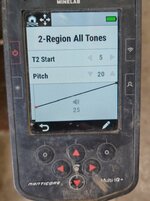
With the Nox 800 I used 50 tones, with the Manticore it is 2 region All Tones which is the equivalent, this is set up with an ascending pitch for the diggable signals and a low iron tone for the coke and fine foil. I could never live with 5 regions (5 tones) I found if a target straddled a region/tone break you got a horrible choppy sound, much better to have a "clean" sound. If a target is spread over a range of VDIs it sounds completely different to a tight coin signal so it enables you to make quick dig no dig decisions. I'm digging most non ferrous signals but I've got a good idea before I dig if I have a big bit of can slaw or a chunk of lead under my coil. Also if I'm in an area where I might get old hammered coins I'm paying particular attention to those low tight signals. I guess the multiple tones just allows me to be more productive when I'm searching.
 

Attachments

  • 20240502_125154.jpg
    20240502_125154.jpg
    120 KB · Views: 313
Ok Shiny, let's say you only want to dig high conductors. Why would you need to hear the mid conductors at all? In the same scenario, if you were using full tones, why would you need to hear multiple variations of high conductor tones, considering you would be digging all high conductors anyway?

Put a different way, if you're digging all nonferrous stuff, then what's the point of hearing multiple tone bin frequencies?
The lower tones, and how many make noise, is handy when the target is on edge, other than that, not sure !
too_
 
Back
Top Bottom