

Cherry Picker
Forum Supporter
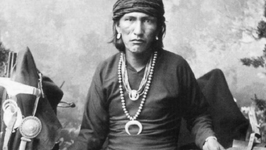
You may remember me posting this find some 13 years ago. I believe it to be a Navajo Naja from a squash blossom necklace. Handmade silver and turquoise. I had sent off some pictures and information to the Chief Curator at the Heard Museum in Arizona and finally got a reply.
"Dear Terry Adams:
Based on the photographs, this does look like a naja or necklace pendant, and could have been part of a larger necklace, typically a squash blossom necklace. The 2 holes in the back of the pendant may have been used for a double necklace strand to pass. There is not much additional information to offer.
She sent me a list of 4 museums to send off for more information. If it turns out to be authentic, I will probably donate it to the Boot Hill Museum. Here is the story of the Navajo squash blossom necklace.
Story of The Squash Blossom Necklaces with the Naja Pendant
For thousands of years, symbols have told stories and have also served as a method to gain power over the forces and the phenomena which affect a society or a person.
The inverted crescent pendant on squash-blossom necklaces, called the 'Naja' by the Navajo, is found in various design forms throughout the world's cultures. As a crescent, this form goes back as far as the Paleolithic period. It is mentioned in the book of Judges as an ornament worn around the necks of camels. In the Phoenician culture, Astarte was the goddess of fertility, and she was represented by the inverted crescent as well. As pendants, the inverted crescent has also been found in ancient Roman and Cretan artifacts.
During the Middle Ages, the Moors rode out of the East and conquered lands in a westerly direction, including eight centuries of occupation in Spain. They adopted the symbol as a bridle ornament, and thought the inverted crescent would protect both themselves and their horses from 'the evil eye'. When the Spaniards came to South and Central America, they brought that same idea with them for the protection of their horses and of their soldiers.
Thus, the Moors taught the Spanish, who taught the Mexicans, who taught the Navajo their belief systems and metallurgy.
Coming from another direction in North America, the inverted crescent symbol was on various types of trade goods brought from the East Coast by other Europeans. The crescent pendant was used from the early 1800's on by the Shawnee, Delaware, Cheyenne, Comanche, and Navajo tribes, among others.
However, metalwork of various European influences was found in the Southwest as early as the 1700's. At this time, the Navajo were fierce warriors who more often raided but occasionally traded with their neighbors, the Plains Tribes.
By the 1820's, Southern Plains metalworkers had learned the processes of cutting, stamping, and cold hammering. Much of this work was produced in German silver. German silver was a different alloy compared with Mexican silver.